Showing posts with label art. Show all posts

Saturday, January 19, 2013

Li Lanqing, British Museum

I called in at the box of delights which is the British Museum on my way to meet some friends in London last week. I like picking a theme when I go, as it’s otherwise impossible to choose where to go, and you end up stumbling from room to room in a kind of nostalgic daze, feeling progressively smaller and smaller as the treasures increase in scale. This time I decided to head to the Americas before anything else, and meandered through the Aztecs, the Arctic and the North American collections.

Before long I found myself predictably off-piste and gazing at a small temporary exhibition in the Far East rooms, 5 or 6 small cabinets containing a collection of of contemporary Chinese seals by Li Lanqing.

Li is an engigmatic figure in modern Chinese politics; he served as Vice Premier of the State Council of China from 1993 to 2003 and played a crucial role in both the opening up of the State economically and the development of national education. Since his retirement from politics he’s turned his energy to the promotion of his two passions – classical music and seal-carving. The latter, one of the four traditional chinese art-forms (along with calligraphy, painting and poetry) is a truly ancient art, and Li’s interest illustrates the dichotomy present in his personal politics; he is a deeply modern man who is simultaneously respectful of tradition. Consequently his seals, which look at first to be deeply conventional, display a great deal of depth – often international in outlook, often witty and wise, always imbued with his passion for life, and very much of the twentieth and twenty first centuries.

His passions shine through; there are stunningly beautifully wrought expressions and aphorisms (the tiny, contained ‘Eat like an ant’ and the wide, spare ‘My heart calm as the water’), and tributes to great figures like Dickens, Goethe and Cervantes. His ‘Opera Disc’ seal, with its use of the English language subverts the geographic specificity of his usual work.

One seal, Baiting Roast Duck Restaurant (Bad Officials are Examined by an Illiterate Person), provides a great example of Li’s playfulness. Featuring some strokes carved to print in red and some in white, the seal mimics a malfunctioning neon sign with half it’s lights out. Moreover, each colour’s message reads differently; the white a traditional advertisement for a famous Beijing restaurant, the white a critique of hapless officials.

It’s a lovely small exhibition, and a little, light-filled window into a big, powerful, slow-changing, subtle China.

Tuesday, December 29, 2009

craigie aitchison

Oh, I always miss news at Christmas - too focused on all the adornments of the festive season to trawl through the paper, and days behind as a consequence. Just flicked through the papers and seen that Craigie Aitchison has died. Now, when I was first beginning to express an interest in art, but struggling to really work out what I liked (as opposed to what I thought I should like), some of Aitchison's paintings were amongst the first to really get through to me. So I'm sad about this. Here's some examples of his work - and here's the Guardian obituary.

Sunday, December 06, 2009

the london perambulator

A couple of weeks ago myself, Vic, Dan, Ant and Alec went down to the Sallis Benney Theatre to see the screening, as part of the Cinecity Brighton Film Festival, of John Rogers’ new film, London Perambulator, a wonderfully affectionate portrait of Nick Papadimitriou, a writer who lives in North London – in my old haunting ground of Barnet, no less - who dedicates his life to the pursuit of what he calls ‘deep topography’; what you and I might have heard described as ‘pyscho-geography’ – urban exploration through the medium of walking, enacted not through pre-researched routes but by chance and happenstance, working on the assumption that the mysteries of the landscape will be revealed through being ‘found’.

As that muddled definition implies, the practice of deep topography is an inexact thing, occupying a vague, semi-mystical space between geography, anthropology, philosophy, art and science. What Nick Papadimitriou does, essentially, is walk through the overlooked corners of cities, and writes about his experience. His preoccupation is not with finding conventional beauty, whether ancient or modern, but rather in examining the functional areas where mankind, nature, and necessity overlap. In the process of this obsession, which sees him undertaking long ruminative walks, creating a kind of philosophical mind-map of the city, he has carried out research – and acted as somewhat of a poetic muse – for the likes of Will Self and Iain Sinclair (whose own book, ‘London Orbital’, sparked my interest in this area).

Papadimitriou is self-evidently an idiosyncratic individual, pursuing with admirable single-mindedness a line of enquiry which many would dismiss as eccentric. Rogers’ film cannot help but play on this, observing its protagonist in reveries of post-industrial romanticism, waxing lyrical over water treatment plants and manhole covers, standing rapt on brownfield sites transfixed by concrete posts. As one might expect of a close confidante of Will Self, Papadimitriou is not only incredibly literate but also extremely funny. So it’s easy for the film to poke affectionate fun at him, not least because a contributor like Russell Brand – who is insightful throughout – can’t resist sending him up.

Speaking after the film – which is only 45 minutes long – Papadimitriou expressed a little wry frustration at the fact. And that is understandable; there is something innately comic about the intensity of his passion for, say, Mogdon Water Treatment Plant – but the film plays up his eccentricity without sacrificing the opportunity to include many thought provoking and poetic displays of language and thought. And the more involved with his subject matter he gets the more profoundly interesting he becomes. It’s in Middlesex, that absent county at the top of London that was folded into Hertfordshire, Surrey and Greater London but which retains a geographical presence of its own, that his most fervent interest resides, and for a period in the film I found myself transported back to the vocabulary of my youth – Barnet, Southgate, Potters Bar, Finchley, Hendon. Papadimitriou is not myopic in his interests – he has a long term plan to walk across the Ukraine – but it’s obvious where his heart resides. He tells us:

“My ambition is to hold my region in my mind… so that I am the region. So that when I die I literally do become Middlesex in some way. For me that is my highest spiritual aspiration, I will be the tarmac that you race along on the A41-T, I’ll be absorbed into the mildewed lintels hidden in overgrown knotweed by the side of the Hendon way…”

My own youth was spent mapping out this part of the world; rambling through Hadley Wood, waiting for tubes into the city at Oakwood station, tracing cycle paths through Totteridge, scrabbling over high fences to let off firecrackers behind the Sainsbury’s car-park in New Barnet. I’m not especially nostalgic for those years, but Papadimitriou’s enthusiasm is infectious. I understood him best, I think, when he stopped suddenly between two semi-detached houses in a glum suburb, and pointed out the contour of the ageless landscape through the gap; where a river once flowed. These buildings, he pointed out, could be destroyed in moments, but it would take something immense to change the shape of land which has held its form for thousands of years.

I’m not sure I fully understand to what end his infectious, limitless enthusiasm can be taken, but in his current role, mid way between philosopher and naturalist, urban historian and dreamer, it strikes me that Nick Papadimitriou is doing something terribly important – chronicling parts of the city which are all around but rarely seen; liminal, overgrown, ambiguous places where mankind has made marks on nature which we would do well not to forget. Their unsystematic, unresolved, chaotic distribution seems to have some significance when counterbalanced against our own unsystematic, unresolved, chaotic lives.

You can watch a short clip of John Rogers’ incredibly enjoyable film below, visit his website here, or download the regular podcasts (“Ventures and Adventures in Topography”) which he and Nick make for Resonance FM here. Nick’s own website, misleadingly named Middlesex County Council, and as chaotic a site as you might expect, is essential reading. Here’s the link.

http://www.middlesexcountycouncil.org.uk/

Thursday, March 19, 2009

thank goodness for that

No Stone Roses reunion. Here's John Squire's latest artwork.
Some things are best left alone. Remember them this way:

Wednesday, August 20, 2008

pick up a pigeon

I love getting nice things through the post. This bundle just arrived from Debbie, who writes the lovely Kept In A Jar blog, and of whose artistic talents I am most envious.

Wonderful! You can buy your own pigeon in Debbie's shop on Etsy.

Tuesday, August 12, 2008

heavy shit

Direct to you from the Guardian Website.

Giant turd wreaks museum havoc
A giant inflatable dog turd created by the American artist Paul McCarthy was blown from its moorings at a Swiss museum, bringing down a power line and breaking a window before landing in the grounds of a children's home.

The exhibit, entitled Complex Shit, is the size of a house. It has a safety system that is supposed to deflate it in bad weather, but it did not work on this occasion.

Juri Steiner, the director of the Paul Klee centre, in Berne, told AFP that a sudden gust of wind carried it 200 metres before it fell to the ground, breaking a window of the children's home.

No more words necessary, I think you'll agree. Full story here.

Friday, August 01, 2008

the whole shebang

Shebang is a fanzine put together by Liv Willars and Lynsey Woods, and it is one of the most beautifully designed and carefully constructed fanzines I’ve seen. Much effort has clearly been put in on Lynsey’s part putting together an attractive, cohesive page design and the team have commissioned an attractive selection of line-drawings, collages and paintings to illustrate their articles, which themselves demonstrate a satisfying breadth of content.

Although a majority of the features relate to pop music – with decent interviews with the excellent Peggy Sue and the young, eager Poppy & The Jezebels – Liv has been careful to commission articles on photography, art and travel, and it’s in these respects that the fanzine really excels. I’d much, much rather read an article about Berlin or Ghent than I would another indie band, and Tilly Stasiuk’s description of her Geisha makeover is fascinating stuff. When the fanzine dips into popular culture territory to talk about the Mighty Boosh, it takes an unexpected and welcome approach, talking to the prop master who worked on the first series of Julian Barratt and Noel Fielding’s show. It provides for energetic anecdotes and a view of the duo we’re not familiar with.

Some of the features are possibly under-written, and would benefit from more detail, but the overall feel is impressive. It’s a cleverly curated and beautifully executed effort, and hopefully the first of many. Feeling a bit inspired, I dropped them an email a month or two ago asking if they wanted any contributions. I’ve had no reply, which is probably for the best – it points to the fact that they’ve got plenty of stuff lined up for future editions. This is a fanzine definitely worth keeping your eye out for.

What I don’t know, unfortunately, is how to stress the title. Is it shebang or shebang? I don’t know, but I’m guessing it’s an ambiguity that Liv and Lynsey are happy with; both emphases seem equally appropriate.

You can buy the fanzine at http://www.shebang-mag.co.uk, or find it for sale in the following Falmouth shops: Jam, Here&Now and Babahogs, as well as in Brighton's Resident Records and Stand Out Records in Salisbury! There's even, wonder of wonders, a Facebook group, here.

Sunday, July 13, 2008

gemma correll

Really in love with the drawings on this blog; they're incredibly cute and appealing. The author, Gemma Correll, is an illustator based in Norwich. According to her profile, her interests are "mexico, circus freaks, screen prints, cats, kittens, kitsch, language, flamenco dancers and vintage adverts".

Here's one of her drawings, please do go and have a look at some of her others, they're really ace:

And you can buy a t-shirt she's designed here. I'm going to order one.

Wednesday, July 09, 2008

etsy is brilliant

Am I alone in having never heard of this site before? Etsy is fantastic - tagged as "your place to buy and sell all things handmade", it's exactly that, a kind of brilliant, vivid mix of ebay, portobello market and ffffound; well designed things that you can buy. Don't be put off by the fact that it's American - they've calibrated it so that international purchases are not a problem.

Oh no, I'm clearly going to spend money there.

Thursday, January 31, 2008

ffffound.com

I'm totally addicted to Ffffound.com, a web service that allows people to save and share their favourite images from the web; it's full of utterly lovely visuals. Here are a few examples:

It's in closed beta at the moment, and I don't have an invite. Hmph. Probably cause they know the whole thing will work beautifully 'til they let the likes of me join in the fun...

Friday, January 11, 2008

santiago sierra

I'm hoping to get up to London tomorrow to catch a couple of exhibitions, and one of the prospective shows is Santiago Sierra's latest at the Lisson Gallery. I've not seen much of his stuff previously, but my interest is very much piqued by Siobhán's interesting examination of his themes and approaches over the years, and in the strong anti-establishment current which runs through (and perhaps contradicts) his art.

Here's Siobhán, over at her Wigglymittens blog, on one previous work of his:

"Sierra takes the idea of exclusivity and the art gallery to an extreme. In 2003 he was chosen to represent Spain in the Venice Biennale. He erected a brick wall at the entrance of the Spanish pavilion, and set up a customs style checkpoint. You could only enter the pavilion if you possessed a Spanish passport. Once inside, the gallery space was barren and empty, but the point of the piece was not the space itself, as with the Lisson piece, it was what access to the space symbolized. The idea that the art gallery was run on a closed set of values put forward in ‘Inside the White Cube’ is what Sierra put into question in this piece, swapping one value system, based around art, for another one, based around nationality and normally common at border controls."
And here are some of Siobhán's thoughts from the end of her piece.

"If Santiago Sierra’s work were situated outside of the gallery context, it would not be art; it would be the everyday- people working in bad jobs for little money. Sierra needs the gallery space to give his work context, and however much he rails against it, it is vital in validating the pieces he makes as being art, therefore however much Santiago Sierra claims to challenge and highlight exploitation and power structures he still relies on institutions and people with the power to give his work context. Although he appears to be than biting the hand that feeds, he's merely sucking at it with toothless gums."
Click here to read her post in its entirety.

Wednesday, November 07, 2007

lovely mural in san francisco

I'm a massive fan of murals, and saw some of the best I've ever seen in San Francisco - it's not exactly surprising given the counter-cultural bent of the city, but from Haight to the Mission there are some dazzling works. Particularly taken, then, with this new one, via Boing Boing. It's located in the colourful Balmy Alley, and is really great.

Friday, July 27, 2007

plans for brighton

Brighton, my home town, has changed a lot since I moved here nearly ten years ago. It has a bright and successful (if rather deadening) shopping centre (Churchilll Square), a beautiful and much-loved new library in the North Laine, a variety of attractive new residential buildings. All of this without losing its scruffy, individual charm. There are plenty more developments lined up, too - the New England district, having been a wasteland sprouting cranes for several years, is coming together, a tall and impressive observational tower (the i360) will shortly be built on the sea front, and the beautiful and controversial Gehry buildings are finally approved. The Brighton Centre and Odeon, two ugly spots on the otherwise beautiful seafront, will be demolished soon, apparently. Most recently, the Local communities secretary, Hazel Blears, finally gave the go-ahead for Brighton and Hove Albion to build an attractive new stadium in Falmer, just outside the city. This is wonderful news for Brighton. Next on the list, I assumed, was the old pier, still standing forlorn in the water, a burned out shell of its former glory.

But no, it seems like the ever changing city will be developed in an unexpected fashion, next, if Council plans are given the go-ahead. The Evening Argus this week revealed a selection of exciting plans to renovate the three major gateways to the city, Preston Road, London Road and Lewes Road, long run-down and neglected parts of our town. The proposals - which at the moment are just that - look genuinely promising, and if a third of what is planned is completed it will be a great step forwards. The plans are outlined below. Thoughts from Brighton residents or interested observers are most welcome.

Lewes Road - this rather unattractive thoroughfare of the city, on the way out to the universities, has long been the most affordable area for student housing, and is at present a busy but unappealing road consisting mostly of funeral parlours, takeaways and budget grocers. The council plan to turn this area into an academic corridor, adding a public square at the Vogue Gyratory, demolishing Sainsburys and the petrol station and encouraging improved shop fronts. They intend to line the road with trees, ban fast food outlets and move Moulescombe station southwards to join it better with the city.

London Road - the closest that Brighton has to a suburban shopping street, London Road is ripe for regeneration sitting as it does in a valley, making high rise development feasible in a city which is famously protective of its skyline. To the west of the high street, the council has already invested in a dense outcrop of buildings, centred on a new Sainsburys, which they hope will provide a new focus for local jobs. But far from reimagining London Road as a financial district, the council see it, post-development, as a new arts district. It's the soon-to-close St Peter's Church which will serve as the catalyst, as it is soon to be converted into a 'cultural centre', complete with art studios. Elsewhere, the open market, a crucial but run-down part of town, will be completely redeveloped and renovated. The approach to the seafront will be transformed into a "green boulevard leading from The Level to the seafront, cutting the fourlane carriageway to the west down to a bus lane and moving all other traffic to the east". There'll be a new car park, too, traffic fans.

Lastly, Preston Road, the main approach to the city, will be similarly redeveloped, focusing on fixing the unused or innapropriate commercial properties and developing the viaduct into a proper Brighton landmark, complete with 'imaginative lighting' and space for 'creative business looking for bespoke accommodation in a high quality, unusual environment".

This all sounds like a lot of work, but (with the possible exception of the Lewes Road 'academic corridor', which may house a lot of students and be on the university route, but which hasn't in the last ten years supported a single bookshop) it all sounds plausible and beneficial to the city, If some of these proposals are carried out Brighton will be all the better for it,

shrigley record coming

I've always got time for David Shrigley's cartoons, they're wonderful, but I'm as much a fan of his words as his drawings, so I'm pleased to hear that - after the lovely Scout Niblett song 'Dinosaur Egg', which married Scout's music to a lyric from Shrigley's LP without music, 'Worried Noodles' - the record label TomLab have put together an entire album where some seriously good artists are given free rein to interpret some of Shrigley's imaginary songs. Brilliant.

Artists represented include the redoubtable Niblett, Deerhoof, David Byrne, Islands, Liars, Trans Am, Hot Chip, Les Georges Leningrad and Franz Ferdinand. Which all sounds rather ace.

Here are some of the words they will be singing.

"Elaine"
Elaine is a danger
To herself
And other people
Elaine is a danger
And is not allowed
In the metal workshop
In the chemistry lab or
In the sports hall
Elaine is a danger
And must not be given pens
Elaine is a danger
And must only write in crayon
Elaine is a danger
And must not go
Near the windows
Or the fishtank
Or in the cupboard.

"The Bell (1:55)"
I heard the bell ringing
Ding-dong Ding-dong
There was a funeral
Ding-dong Ding-dong
Lots of people at the funeral
Ding-dong Ding-dong
Funeral of a rock star
Ding-dong Ding-dong
Who died in a fight
Ding-dong Ding-dong
He got his head punched off
Ding-dong Ding-dong
By a 12-foot monster
Ding-dong Ding-dong

"The King (2:52)"
I am the King of it all
And you R my subjects
I am the King of it all
And U R my subjects
Don't believe me?
Ask the police!
They will beat you up for asking.

Extract from "Ding Dang"
Squirrel squirrel
In the tree
Do me a favour
Collect Nuts for me
Do me a favour
And take the shells off
The nuts
And examine them closely
To check they are not
Rotten
Before you give them to me.

Nut Nut
Beautiful nut
Salt nut
Spicy nut
You're a good old nut
And I love you

Tuesday, May 22, 2007

history via r. crumb

When I was over in San Francisco I managed to miscalculate how much time I'd have on my last day, and woke up early, packed my bags and checked out of the hotel. Sitting having breakfast in a diner around the corner from Powell St, I pulled my itinery out of my rucksack and worked out how long I had until my flight - six hours!!! It was a happy realisation, a little gift of time which I hadn't bargained on, enabling me to do one last thing before I returned to the UK.

I knew immediately what I wanted to do. The day before I had headed over to the Yerba Buena Centre for the Arts hoping to see an exhibition of Robert Crumb's comic book drawings, which included a selection of new stuff as well as old, but was disappointed to find that the museum was closed on Mondays and had to miss out. So I jumped on the underground and dashed over, only to find the place still closed. Only because I was too early, though. As I've mentioned before, the weather in San Francisco was ludicrously hot, so I sat prone in the sun at the neighbouring park, allowing the fine spray of a nearby fountain to cool my arms. Soon enough, the doors sprang open and I raised myself and went in.

Crumb's drawings are fascinating - all are highly detailed, allowing no opportunity to document the texture of skin to be passed up, and many highly immature and adolescent, raising a contrast between Crumb's naivity and his interest in social degredation and sex. Some of the drawings portray women in a pretty unforgiving light, yet Crumb details men's failings, sexual and otherwise, with an equal frankness. Perhaps the most moving drawings are those which deal with Crumb himself, particularly an inability to vocalise his feelings - which manifests itself in one particularly lovely comic strip where, standing to face the reader, he can think of so little to say, and feels so awkward, that he is reduced to singing a song, moving from nervous to enthused and back to awkward in a series of highly comic frames. His interest in ennui means some of the drawings really do explore life in some philosophical depth - and yet others remain frank, filthy and funny.

By far my favourite is a drawing I've written about on this blog before, but can't resist reproducing again. His 'Short History of America' (below, click to enlarge) is just magnificent, one of my favourite works of art of the twentieth century - I don't care that Crumb is a comic book artist; the 12 frames of this drawing buzz with meaning, emotional currency and history. Brilliant stuff, and a brilliant exhibition.

Tuesday, May 08, 2007

map-making

Whenever I go somewhere new, I find myself creating mental maps of the place, both unconsciously (because I love maps, and it's instinctive) and deliberately (because it helps me get about). Another kind of map is a kind of map-plan which lays out the things I want to do in the order I want to do them. Being in San Francisco for only a few days means I have to do this quite carefully, observing the nearest points across the map and across the city and watch for ways to tighten the thread of my movements without the thread become tangled. Does that make sense? Perhaps not.

I had it in mind all week that one of the first things I would do in SF is go to the Museum of Modern Art, and funnily enough it was one of the first buildings I passed, getting a cab from the Caltrain station to my hotel that first evening. Then, somehow, getting excited about the things to do and the great advice that various friends have given me, I left it off all my maps and forgot to do it. Today I got up lateish and decided to jump on the Bart over to Montgomery and walk up through Chinatown to North Beach, specifically so I could go to City Lights and stop by at Vesuvio, which was recommended to me by both Dave and Dustin.

Getting to Montgomery, I suddenly remembered that I had forgotten all about SFMOMA, but remembered that it was close by so tracked back and found it. I'm really glad I did. I didn't pay to go into the Picasso and American Art exhibition, and was disappointed to find that the photography work was out of bounds today, but I did spend a calming hour and a half walking through the cool, white curved corridors of the building, admiring the paintings. Seeing some was a revelation - Jasper Johns' Flag (below) occupies the same place in my subconscious as Kerouac's On The Road, a vital, instructive work which informed the tap-tap progression of my interests. Less pretentiously, I was about 14 when I discovered both the beats and the pop art painters, and both blew my mind.
Best of all in the museum, though, was the magnificent exhibition of paintings by Brice Marden, which took in his pavement style slabs of colour, more refined flag-style triptychs, his stunning Cold Mountain squiggles and pages from his notebooks, which were more jagged and erratic. The Cold Mountain paintings, and his amazing Study for the Muses (below) were the highlight. I spent about quarter of an hour following the lines, falling into a reverie. When I was little, besides drawing maps, I liked drawing mazes, and watching the undulating curves of his work reminded me of the process of creating them.

Finished there, I walked up to City Lights. Crossing the door into the bookshop felt stupidly significant, like a step I was always going to make and finally did, which I suppose, in fact, is true. I went up to the poetry room and stood there in the silence, grinning, then went and touched all the books I read when I was a teenager - Ginsberg, Ferlinghetti, Faulkner, Kerouac, Wolfe, Hunter Thompson, Steinbeck, Burroughs.

I smiled when I saw a copy of David Berman's Actual Air out on the recommendations table, and thought of one his simpler lines - "half hours on earth / what are they worth? / I dunno". And I felt like I had a slightly better idea, now.

Tuesday, December 12, 2006

a blog worth sticking with

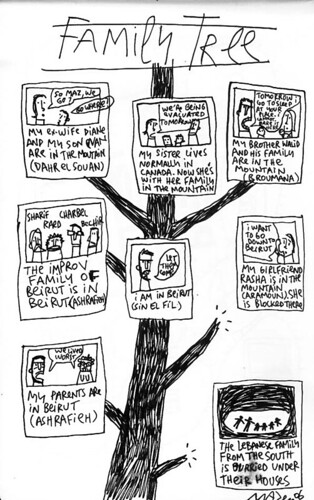
One of the blogs I've visited most often over the last few months is Mazen Kerbaj's beautiful Kerblog, which collects together his drawings and doodles - it's a wonderful site, full of great images, rich colours and hugely evocative detail; Mazen blogs from Beirut, so he's had plenty to draw and write about. Today's picture is vivid and gorgeous; other entries, like the one I'm reproducing below, are plain moving. Brilliant stuff.

(c) Mazen Kerbaj, reproduced without permission, hope that's OK.

You can see all of Mazen's drawings over at Flickr, too. Really really really worth a look. His website, meanwhile, is here.

Thursday, June 08, 2006

gary hume at the white cube

I hardly ever make it to art shows, but I have been getting quietly excited at the prospect of the new Gary Hume show at the White Cube. Disappointing, then, to see it raising a sigh - if a rather beautiful sigh - rather than a gasp in Jonathan Jones's Guardian review. Yet reading it also makes me feel rather pleased that my gallery attendence has been so poor over the years; I've never identified Hume that strongly with the yba thing, or at least not so much to care about it, and I've always liked his stuff more than his contemporaries because I find it thrilling beautiful, even if it's all gloss paint and surface. Jones writes:

"Whatever emotions are teased into play didn't nourish me beyond the walk back to the tube. As with many of his paintings, the feeling doesn't quite gel. It stays in a shallow part of you and is blown away with the dust of the street. Which, you might say, is how art ought to be. But then why does it need to be so expensive, difficult to make and ostentatious? Hume confuses me. Sometimes he seems to have a direct connection with a place in the collective unconscious where giant flowers bloom. At his best, he beautifully evokes London at a particular moment. Trouble is, that moment was a decade ago."

Perhaps if I had spent my teens in Hoxton rather than Camden I'd feel the same way - as it is, unless his new work is an enormous departure, I still find myself thrilled. And Jones's description is a good one for Hume - the artist of giant flowers.

Suddenly I'm reminded of a moment on (hesitates and then says quietly) Big Brother the other night which would have been unspeakably mawkish in the hands of anyone else, but Pete, who I rather like, said that when he feels free and happy he feels exactly like a bird, and when you feel like a bird you need other birds to fly with you. But the people here, he remarked, are all cats. I know. But I am cheered for a moment by a glimpse into a mind where giant flowers bloom; I bet Pete would like Gary Hume's paintings. Then my cynical self re-enters and the flower-bearers are sent squawking from the room.

The Hume exhibition runs at the White Cube until July 1st, and my bet is on it being a good show.

Monday, October 03, 2005

patrick caulfield

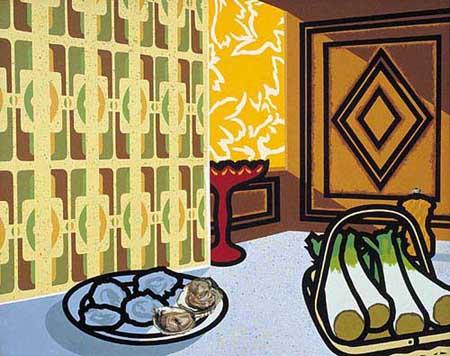
Many of us wish we knew a lot more about a lot more things, and there are few areas which I wish I knew more intimately than art, which is a subject for which I can not do expertise but have mastered enthusiasm. There are about ten paintings, moreover, about which I know comparitively little and yet feel without doubt that they are of real importance to me. Hockney's Mr and Mrs Clark and Percy, Chris Ofilli's No Woman No Cry, Stanley Spencer's Swan Upping at Cookham, Lucien Freud's Leigh Bowery (Seated), and Begging For It by Gary Hume are just some examples. Another picture which I know so well I don't even need to see it any more is Patrick Caulfield's lovely After Lunch. Caulfield died on September 29th and that painting has been lovingly reprinted throughout the British press in the last few days. So here's another painting by Caulfield, and a link to his obituary from today's Guardian.

'Still life: Autumn fashion', 1978, by Patrick Caulfield (b. 1936)

Thursday, June 02, 2005

more on the turner

Further to my post about the Turner shortlist, here's how the Turner Prize judges describe the finalists:

Darren Almond's work addresses the themes of time, geography and memory. He uses a wide range of media, including film, photography and sculpture to explore the passing of time and the marks that it leaves on both social and private histories. He is shortlisted for his exhibition at K21, Kunstsammlung Nordrhein-Westfalen, Düsseldorf.

Gillian Carnegie explores the properties of painting. She works within the traditional genres of landscape, still life, the nude and portraiture, incorporating a wide variety of subjects and techniques to both celebrate and question the medium. She has been shortlisted for her solo exhibition at Cabinet, London.

Jim Lambie makes exuberant installations and sculptures that make reference to pop music and youth culture. He uses everyday materials, including coloured tape and glitter to transform spaces and familiar objects. He is shortlisted for his exhibitions at Sadie Coles HQ, London and Anton Kern, New York.

Simon Starling transforms and reframes existing objects through a rigorous process of research. In his complex sculptural installations he creates poetic narratives by drawing together disparate cultural and historical references. He is shortlisted for his solo presentations at the Modern Institute, Glasgow and the Fundació Joan Miró, Barcelona.